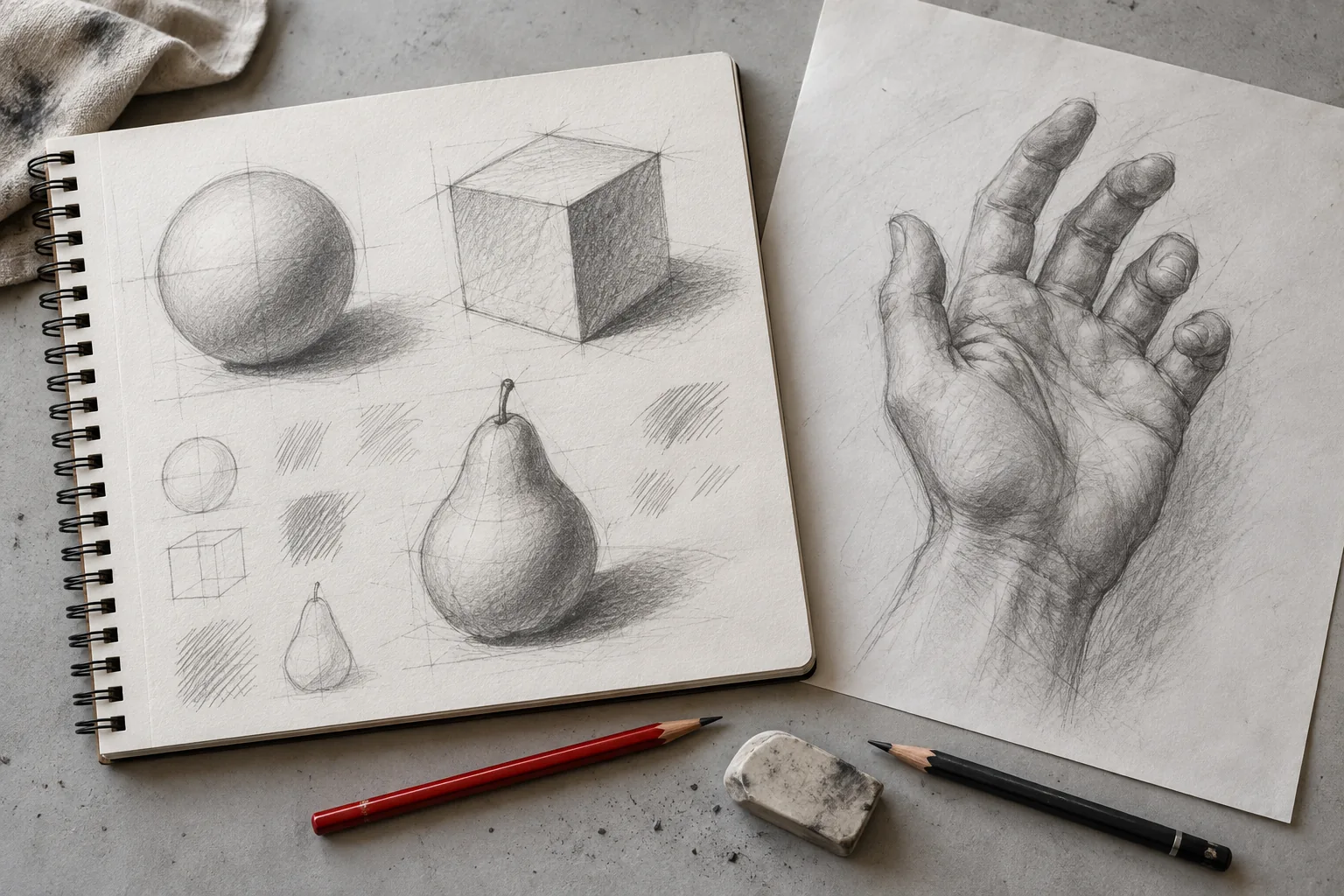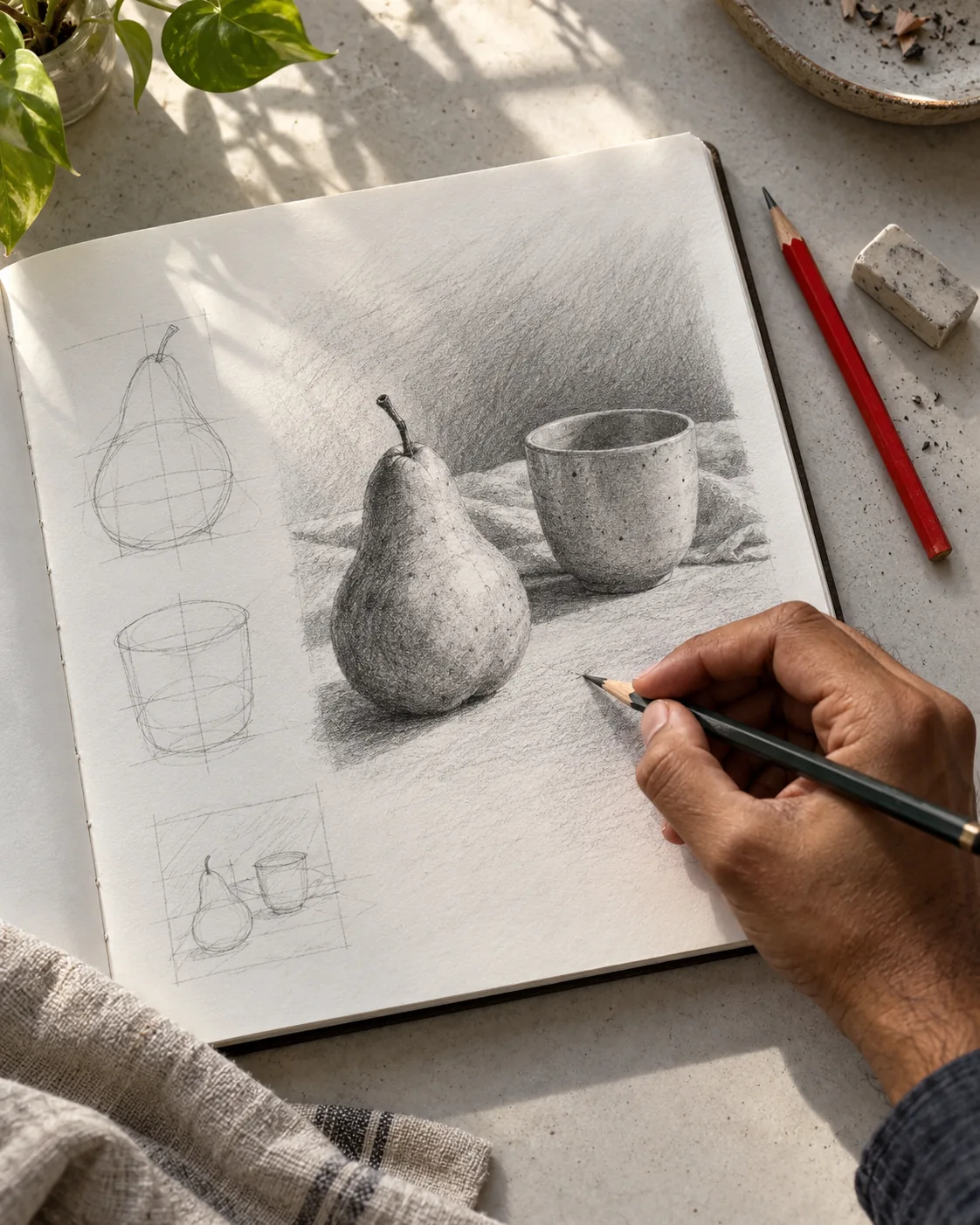
It is tempting to measure sketching progress by how impressive a finished page looks. But a beginner’s useful work often happens in small, unfinished studies: comparing an angle, drawing an ellipse again or changing a proportion before adding detail.
A practical routine gives these decisions a place. You do not need to draw for hours or buy new supplies to try it. Begin with one ordinary object and a question you can investigate on paper.
Make your setup easy to repeat
Keep a pencil, an eraser and a sketchbook where you can reach them. Choose a familiar object such as a cup, spoon, shoe or small box. Leave it in a stable position while you draw, rather than moving it around between observations.
Use a comfortable light source that lets you see the object’s large shadow shapes. If you practice from a photograph, keep the same reference for the exercise. Changing both the subject and the skill every day makes it harder to understand what changed in your drawing.
Warm up for the task, not for a ritual
A warm-up is useful when it prepares you for the drawing in front of you. If your subject contains a cup’s rounded rim, practice a few light ellipses. If it has long angled edges, try a handful of deliberate lines between two points.
Do not turn the warm-up into another obstacle before starting. Its purpose is to make the relevant movement feel less unfamiliar. Stop when you are ready to apply it to the subject.
Block in the large relationships first
Look at the subject’s overall height and width. Place a light bounding shape on the page and indicate its main direction. Add simple shapes for the large parts before tracing every visible edge.
For a shoe, you might begin with the overall wedge-like form and the curve of the opening. For a cup, compare the body with the opening before building the handle. These decisions will affect the drawing more than the first small detail you notice.
Keep the construction light enough to revise. Pressing hard is not a sign of confidence if it prevents you from adjusting an early guess.
Give each repetition a different purpose
Drawing the same subject again is useful when you change what you pay attention to. Otherwise, repetition can mean repeating the same uncertainty.
Try this sequence:
- Make a small outline study focused on height and width.
- Draw another version focused on the main angles and empty spaces.
- Try a third version using only a few broad light and dark areas.
You are not required to finish every version. Each one investigates a different part of the subject. Write a short note explaining what you were checking so that the page is useful later.
Compare attempts fairly
Compare drawings of the same exercise rather than a simple early sketch with a complex later subject. Look for a change you intended to make: a better relationship between two shapes, a more consistent ellipse or a clearer grouping of values.
Date your attempts. Notice what you did differently, not just which drawing you like more. Sometimes the more useful attempt is the one where you caught an error early, even if you did not finish shading it.
Avoid comparing your practice page with a carefully selected finished artwork online. You do not see the preparation, references or discarded attempts behind that image.
Use feedback when you cannot name the problem
If the sketch still feels wrong and you cannot identify the issue, ask for help with the exercise’s goal. Show your reference and explain the part you were checking. A mentor can help you decide whether to focus on proportion, form or another foundation.
Apply one observation before requesting another broad review. Our guide to using drawing feedback explains how to turn a comment into an actual practice task.
Make the next session obvious
Before closing the sketchbook, leave one small instruction for next time: “Check the cup’s width before its handle” or “Use three values for the pear”. A clear task makes returning easier than deciding again how to “get better”.
For a ready-made sequence, explore NIDAL’s drawing path and start the free first chapter. The purpose of the routine is steady, useful practice, not a promise that everyone will improve at the same speed.